Currently Empty: R0.00

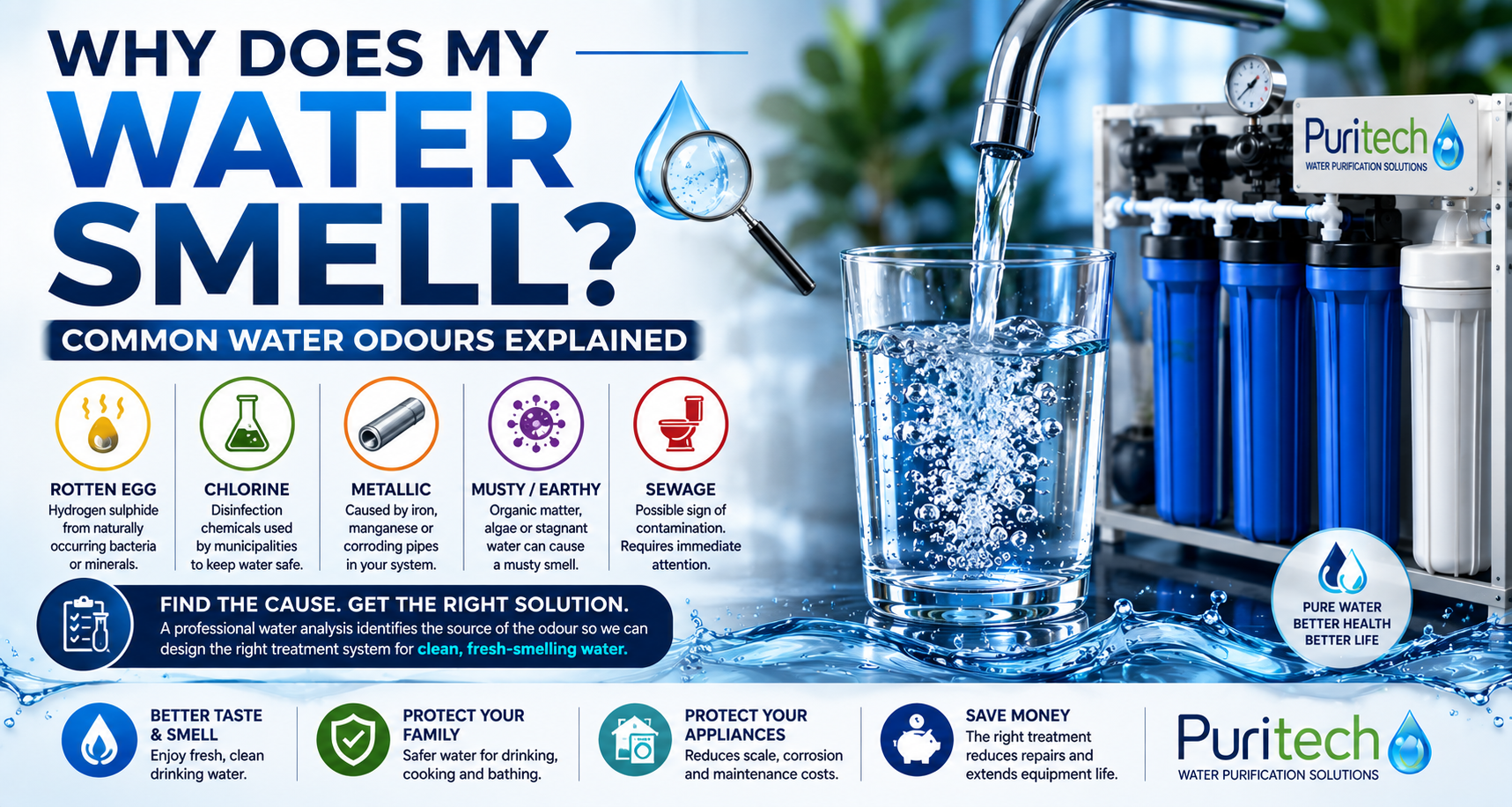
Why Does My Water Smell? Common Water Odours Explained
A persistent water smell can quickly turn something as simple as drinking a glass of water or taking a shower into an unpleasant experience. Whether your water smells like rotten eggs, chlorine, metal, mould, or chemicals, unusual odours are often a sign that something in your water requires attention.
While some water odours are caused by naturally occurring minerals, others may result from bacteria, ageing plumbing, treatment chemicals, or environmental factors. A water smell does not always indicate that the water is unsafe, but it should never be ignored. Identifying the source of the odour is the first step toward selecting the correct water treatment solution.
At Puritech, we always recommend starting with a recent professional laboratory water analysis. Understanding what is causing the odour allows us to design a treatment system that addresses the problem effectively rather than simply masking the smell.
Why Does Water Smell?
Water is naturally odourless.
If your water develops an unusual smell, it usually means that dissolved substances, gases, bacteria or other compounds are present.
These may originate from:
- Underground geological formations.
- Municipal treatment chemicals.
- Naturally occurring bacteria.
- Borehole water chemistry.
- Ageing plumbing systems.
- Hot water systems.
- Organic matter.
- Environmental contamination.
The type of smell often provides valuable clues about the underlying cause.
However, smell alone cannot identify the exact problem.
Professional testing remains the most reliable method of determining what is affecting your water.
Why Clear Water Can Still Smell
One of the biggest misconceptions is that if water looks clean, it must be clean.
In reality, many substances responsible for a water smell are completely invisible.
For example:
- Hydrogen sulphide gas causes a rotten egg smell.
- Chlorine leaves a noticeable chemical odour.
- Dissolved metals may create a metallic smell or taste.
- Organic compounds can produce earthy or musty odours.
Crystal-clear water may still contain compounds that affect its smell, taste, or suitability for certain applications.
Municipal Water vs Borehole Water
The source of your water often influences the type of odour you experience.
Municipal Water
Municipal water is treated before distribution, but certain odours may still occur due to:
- Chlorination.
- Distribution pipe maintenance.
- Seasonal changes in source water.
- Ageing infrastructure.
These smells are often temporary but should be investigated if they persist.
Borehole Water
Borehole water naturally passes through underground rock formations before reaching the aquifer.
During this process, it may absorb:
- Sulphur compounds.
- Iron.
- Manganese.
- Organic matter.
- Dissolved minerals.
Because every borehole is unique, neighbouring properties may experience completely different water quality.
A professional laboratory water analysis is essential before selecting treatment equipment.
Is a Water Smell Dangerous?
Not always.
Some odours are primarily aesthetic, affecting taste and smell rather than safety.
Others may indicate water quality issues that require immediate investigation.
For example:
- Chlorine odour often indicates disinfection.
- Hydrogen sulphide produces an unpleasant smell but is usually more of a nuisance than a health concern at low concentrations.
- A sewage-like smell could indicate contamination requiring urgent professional attention.
Rather than making assumptions, it is important to determine the exact cause.
Common Causes of Water Smell
Several factors may contribute to unpleasant odours.
These include:
Naturally Occurring Minerals
Certain underground minerals interact with water and create distinctive smells.
Dissolved Gases
Hydrogen sulphide is one of the most common causes of rotten egg odours in borehole water.
Bacteria
Some naturally occurring bacteria produce gases that affect water smell without necessarily making the water unsafe.
Municipal Treatment Chemicals
Chlorine and chloramine are commonly used to disinfect municipal water.
Although effective, they may produce noticeable odours.
Organic Matter
Leaves, algae and other natural organic material may contribute earthy or musty smells.
Plumbing Systems
Old pipes, hot water cylinders and stagnant water inside plumbing systems may also contribute to unpleasant odours.
Why Identifying the Correct Odour Matters
Different smells require different treatment technologies.
For example:
A chlorine smell may be effectively removed using activated carbon filtration.
A sulphur smell may require specialised oxidation and filtration.
Metallic odours may indicate elevated iron or manganese, requiring completely different treatment.
Treating the wrong problem wastes money and often fails to eliminate the odour.
Why Guessing Can Be Expensive
Many homeowners purchase equipment based solely on the smell.
For example:
Someone experiencing a rotten egg odour may immediately buy a reverse osmosis system.
However, if the problem is caused by hydrogen sulphide gas entering the water before it reaches the kitchen tap, reverse osmosis alone may not eliminate the smell throughout the property.
Likewise, replacing filters repeatedly will not solve a problem caused by elevated iron or bacterial activity.
Proper diagnosis always comes before treatment.
The Role of Professional Water Analysis
A professional laboratory water analysis provides far more information than smell alone.
It identifies important characteristics such as the following:
- pH.
- Iron.
- Manganese.
- Sulphates.
- Chlorides.
- Nitrates.
- Total Dissolved Solids (TDS).
- Hardness.
- Microbiological contamination where applicable.
This information allows engineers to recommend the correct treatment system rather than relying on trial and error.
Signs You Should Investigate Your Water
You should arrange a professional water analysis if you notice:
- Persistent unpleasant odours.
- A sudden change in smell.
- Metallic taste.
- Staining on plumbing fixtures.
- Reduced appliance performance.
- Discoloured water.
- Cloudy water.
- Scale build-up.
- Poor-tasting drinking water.
Even if the water appears clear, these symptoms may indicate underlying water quality issues.
Why Every Water Source Is Different
One customer may experience a chlorine smell because of municipal disinfection.
Another customer may have a rotten egg smell caused by naturally occurring hydrogen sulphide in borehole water.
A third customer may notice a metallic odour due to elevated iron levels.
Although all three customers complain about a water smell, each requires a completely different treatment solution.
This is why professional water treatment should always be based on water quality rather than assumptions.
What Happens Next?
Once the source of the odour has been identified, engineers can determine whether the solution involves:
- Activated carbon filtration.
- Iron and manganese removal.
- Sulphur removal.
- Water softening.
- UV sterilisation.
- Reverse osmosis.
- A combination of treatment technologies.
Choosing the right solution begins with understanding the cause—not just the symptom.
Common Water Odours and What They Mean
Not every water smell has the same cause. One odour may simply be the result of municipal water treatment, while another could indicate naturally occurring minerals, bacterial activity, or contamination.
Understanding the type of smell is the first step towards selecting the correct treatment solution. However, it’s important to remember that smell alone cannot accurately identify the cause. A professional laboratory water analysis provides the information needed to recommend the right system.
Let’s look at the most common water odours experienced in South Africa.
Rotten Egg Smell
The rotten egg smell is one of the most common complaints from borehole owners.
What Causes It?
In most cases, the smell is caused by hydrogen sulphide gas (H₂S).
Hydrogen sulphide can occur naturally as groundwater moves through rock formations containing sulphur compounds.
It may also be produced by sulphur-reducing bacteria under certain conditions.
Common Signs
- Strong rotten egg smell.
- Smells often worse after water has been standing.
- More noticeable in hot water.
- Common in borehole water.
Is It Dangerous?
At the concentrations normally found in domestic water supplies, hydrogen sulphide is usually more of an aesthetic problem than a health concern.
However, very high concentrations should always be investigated.
Typical Treatment
Depending on laboratory results, treatment may include the following:
- Oxidation systems.
- Aeration.
- Activated carbon.
- Specialised sulphur removal media.
- Multi-stage filtration.
Every installation should be designed according to recent laboratory analysis.
Chlorine Smell
Many homeowners notice a swimming pool-like smell coming from their taps.
What Causes It?
Municipalities add chlorine or chloramine to disinfect drinking water and protect it during distribution.
The smell may become stronger:
- After maintenance work.
- During warmer weather.
- When chlorine dosing is temporarily increased.
Common Signs
- Chemical or swimming pool smell.
- Usually associated with municipal water.
- Water remains clear.
Is It Dangerous?
In most cases, chlorine indicates that the water has been disinfected.
However, excessive chlorine may affect:
- Taste.
- Odour.
- Cooking.
- Coffee and tea quality.
Typical Treatment
Activated carbon filtration is commonly used to reduce chlorine taste and odour while improving overall drinking water quality.
Metallic Smell
Some water develops a metallic smell or taste.
What Causes It?
Common causes include:
- Iron.
- Manganese.
- Copper.
- Corroding plumbing.
The source depends on both the water chemistry and the plumbing system.
Common Signs
- Metallic taste.
- Brown, orange or black staining.
- Stains in sinks and toilets.
- Laundry discolouration.
Is It Dangerous?
Not necessarily.
However, elevated metal concentrations may damage plumbing fixtures and affect water quality.
Typical Treatment
Depending on laboratory results:
- Iron removal systems.
- Manganese removal systems.
- pH correction.
- Oxidation and filtration.
Musty or Earthy Smell
Water sometimes develops a damp, earthy smell.
What Causes It?
Possible causes include:
- Naturally occurring organic matter.
- Algae.
- Decaying vegetation.
- Certain microorganisms.
This is more common in surface water supplies than deep boreholes.
Common Signs
- Earthy smell.
- Damp or mouldy taste.
- Seasonal variation.
Typical Treatment
Treatment may include:
- Activated carbon.
- Advanced filtration.
- UV sterilisation where microbiological risks exist.
Mouldy Smell
A mouldy smell often resembles damp clothing or a wet basement.
Possible Causes
- Organic contamination.
- Biofilm inside plumbing.
- Water storage tanks requiring cleaning.
- Stagnant water.
What Should You Do?
The source should be identified before treatment is selected.
Simply replacing filters may not eliminate the problem.
Sewage Smell
A sewage smell should never be ignored.
Possible Causes
- Plumbing problems.
- Drain gases.
- Cross-connections.
- Contamination.
- Faulty drainage systems.
Is It Dangerous?
Potentially.
This type of odour requires prompt investigation.
Professional testing is strongly recommended.
Fishy Smell
Although less common, some customers report a fish-like odour.
Possible Causes
- Organic compounds.
- Certain naturally occurring minerals.
- Algae.
- Plumbing materials under specific conditions.
Treatment
Treatment depends entirely on laboratory findings.
Chemical Smell
Some water develops a noticeable chemical or solvent-like odour.
Possible Causes
- Municipal treatment chemicals.
- Industrial contamination.
- Agricultural runoff.
- Plumbing materials.
What Should You Do?
A recent laboratory water analysis should be arranged as soon as possible to determine the source.
Why Does the Smell Only Come From the Hot Water?
This is a very common question.
If the smell only appears when using hot water, possible causes include:
- Water heater reactions.
- Hydrogen sulphide formation inside the geyser.
- An ageing sacrificial anode.
- Temperature-related bacterial activity.
In many cases, the cold water remains unaffected.
Identifying whether the smell comes from the hot or cold supply provides valuable information during diagnosis.
Why Does My Borehole Water Smell Worse After Rain?
Heavy rainfall may temporarily influence groundwater quality by introducing additional organic material or altering groundwater movement.
Changes in smell following heavy rain should always be investigated, particularly if accompanied by changes in colour or taste.
Can Filters Remove Every Water Smell?
No.
Different odours require different treatment technologies.
For example:
| Water Smell | Possible Cause | Typical Treatment |
|---|---|---|
| Rotten egg | Hydrogen sulphide | Oxidation and sulphur removal |
| Chlorine | Municipal disinfection | Activated carbon |
| Metallic | Iron or manganese | Iron and manganese removal |
| Musty | Organic compounds | Activated carbon and advanced filtration |
| Mouldy | Biofilm or stagnant water | Cleaning, filtration and possible UV sterilisation |
| Chemical | Treatment chemicals or contamination | Laboratory analysis followed by appropriate treatment |
| Sewage | Plumbing or contamination | Immediate investigation and corrective action |
This is why installing equipment without first understanding the cause often leads to disappointing results.
Real-Life Example
A customer contacted Puritech because their borehole water had a strong rotten egg smell.
They had already replaced multiple cartridge filters, believing the filters were faulty.
After reviewing a recent laboratory water analysis, it became clear that the primary issue was naturally occurring hydrogen sulphide gas—not clogged filters.
Puritech designed a treatment system with the appropriate oxidation stage and specialised filtration media.
The unpleasant odour disappeared, and the customer avoided spending more money on unnecessary replacement filters.
The solution wasn’t replacing more filters—it was identifying the correct cause.
Smell Is a Symptom, Not a Diagnosis
A water smell is an indication that something has changed or requires attention, but it does not reveal the full story.
Two customers may both describe a “bad smell”, yet one may have elevated chlorine while the other has hydrogen sulphide or iron-related issues.
The treatment approach for each is completely different.
That’s why every successful water treatment solution begins with understanding the water through professional testing rather than relying on guesswork.
How to Eliminate Water Smells Permanently
By now, you’ve learned that a water smell is not the problem itself—it’s a symptom of an underlying water quality issue.
Many homeowners and businesses spend money replacing filters, using bottled water, or adding temporary odour removers, only to discover that the smell keeps coming back.
The reason is simple:
If you don’t eliminate the cause, you won’t eliminate the smell.
The most effective solution always begins with identifying exactly what is causing the odour and selecting the appropriate treatment technology.
Why Temporary Solutions Don’t Work
Some people try to solve a water smell by doing the following:
- Replacing cartridge filters repeatedly.
- Adding chlorine without understanding the cause.
- Installing the wrong filtration system.
- Using bottled water for drinking while ignoring the rest of the water supply.
- Masking the smell with scented products.
While these may reduce the symptoms temporarily, they rarely solve the underlying problem.
Professional water treatment focuses on removing the source of the odour—not hiding it.
Choosing the Right Treatment Technology
Every treatment system should be designed around the results of a recent professional laboratory water analysis.
Here are some of the most common treatment technologies and when they are typically used.
Activated Carbon Filtration
Activated carbon is one of the most widely used filtration technologies.
It is highly effective at improving:
- Taste.
- Odour.
- Chlorine.
- Certain organic compounds.
Typical Applications
- Municipal drinking water.
- Household filtration.
- Commercial kitchens.
- Restaurants.
- Offices.
Activated carbon is an excellent solution for chlorine-related odours but is not designed to remove every cause of a water smell.
Iron and Manganese Removal
If laboratory analysis identifies elevated iron or manganese, specialised filtration media may be recommended.
These systems help eliminate:
- Metallic smells.
- Metallic tastes.
- Brown staining.
- Black staining.
- Orange deposits.
Proper pretreatment often improves both water quality and appliance lifespan.
Sulphur Removal Systems
Hydrogen sulphide requires a completely different treatment approach.
Depending on water chemistry, treatment may include the following:
- Aeration.
- Oxidation.
- Catalytic filtration.
- Specialised sulphur removal media.
Selecting the correct media depends on laboratory analysis rather than smell alone.
Water Softeners
Hard water doesn’t usually produce a strong odour.
However, elevated calcium and magnesium contribute to the following:
- Scale formation.
- Reduced appliance efficiency.
- Soap scum.
- Higher maintenance costs.
A professionally sized water softener protects plumbing, geysers, boilers and household appliances while improving overall water performance.
UV Water Sterilisation
Where microbiological contamination is identified, UV sterilisation provides an effective method of disinfecting water without adding chemicals.
UV systems are commonly used together with appropriate pretreatment to ensure maximum effectiveness.
Reverse Osmosis
Reverse osmosis removes a wide range of dissolved contaminants.
It is often recommended where laboratory analysis identifies:
- High Total Dissolved Solids (TDS).
- Elevated sodium.
- Fluoride.
- Nitrates.
- Chlorides.
- Sulphates.
- Multiple dissolved contaminants.
Although reverse osmosis significantly improves drinking water quality, it is not the universal solution for every type of water smell.
Why One Treatment Doesn’t Solve Every Problem
Consider these two customers.
Customer A
Complains of:
- Strong chlorine smell.
- Municipal water.
- Good laboratory results.
An activated carbon filter may provide the perfect solution.
Customer B
Complains of:
- Rotten egg smell.
- Borehole water.
- Elevated hydrogen sulphide.
This customer requires a completely different treatment process.
Although both customers experience a water smell, their treatment systems are entirely different.
Preventing Water Odours
Preventative maintenance plays an important role in maintaining water quality.
Regular servicing should include:
- Replacing filter cartridges.
- Servicing UV systems.
- Inspecting storage tanks.
- Cleaning pipework where necessary.
- Checking water softeners.
- Monitoring system performance.
- Reviewing water quality if conditions change.
Preventative maintenance often prevents minor issues from becoming major problems.
Why Professional Water Analysis Saves Money
Many customers believe laboratory testing is an unnecessary expense.
In reality, it often saves money by preventing incorrect equipment purchases.
Imagine buying:
- A reverse osmosis system when only activated carbon is required.
- Carbon filters when iron removal is needed.
- Cartridge filters when the problem originates in the geyser.
Professional testing removes the guesswork.
Instead of replacing equipment repeatedly, customers invest in the right solution the first time.
Why Customers Choose Puritech
Every water source is different.
That’s why Puritech doesn’t recommend equipment based solely on smell.
Our process begins with understanding your water.
We provide:
- Professional consultation.
- Review of recent laboratory water analysis reports.
- Custom-designed treatment systems.
- Professional installation.
- Commissioning.
- Preventative maintenance.
- Ongoing technical support.
Whether your water comes from a municipality, a borehole or another source, our goal is to solve the underlying problem—not simply mask the symptoms.
Frequently Asked Questions
Why does my water smell like rotten eggs?
The most common cause is hydrogen sulphide gas, particularly in borehole water. A professional laboratory water analysis will determine the exact cause and the most appropriate treatment.
Why does my municipal water smell like chlorine?
Municipal water suppliers commonly use chlorine or chloramine to disinfect drinking water. Activated carbon filtration is often effective at reducing chlorine taste and odour.
Is a bad water smell always dangerous?
No.
Some odours affect taste and smell without posing a health risk, while others require immediate investigation. A laboratory water analysis provides the information needed to assess your water quality.
Can reverse osmosis remove water smells?
Reverse osmosis removes many dissolved contaminants that affect water quality, but it is not the correct solution for every type of water smell. Treatment should always be based on the underlying cause.
Can I identify the problem just by smelling the water?
No.
Different contaminants can produce similar odours. Professional testing is the only reliable way to identify the exact cause.
Should I replace my filters if my water starts smelling?
Not necessarily.
While clogged filters can contribute to odours, many smells originate from the water itself, plumbing systems or naturally occurring contaminants. Replacing filters without identifying the cause may not solve the problem.
Final Thoughts
A persistent water smell should never be ignored.
Whether your water smells like rotten eggs, chlorine, metal, mould or chemicals, the odour is often telling you that something in your water or plumbing system needs attention.
The good news is that most water odours can be successfully treated once the underlying cause has been identified. The key is avoiding guesswork. Installing the wrong equipment or repeatedly replacing filters without understanding the problem often leads to unnecessary costs and continued frustration.
At Puritech, every recommendation begins with a recent professional laboratory water analysis. By understanding exactly what is affecting your water, we can design a customised treatment solution that improves taste, eliminates unpleasant odours, protects your equipment and provides long-term peace of mind.
If you’re experiencing an unusual water smell, don’t settle for temporary fixes. Identify the cause, choose the right treatment and enjoy clean, fresh-smelling water with confidence.